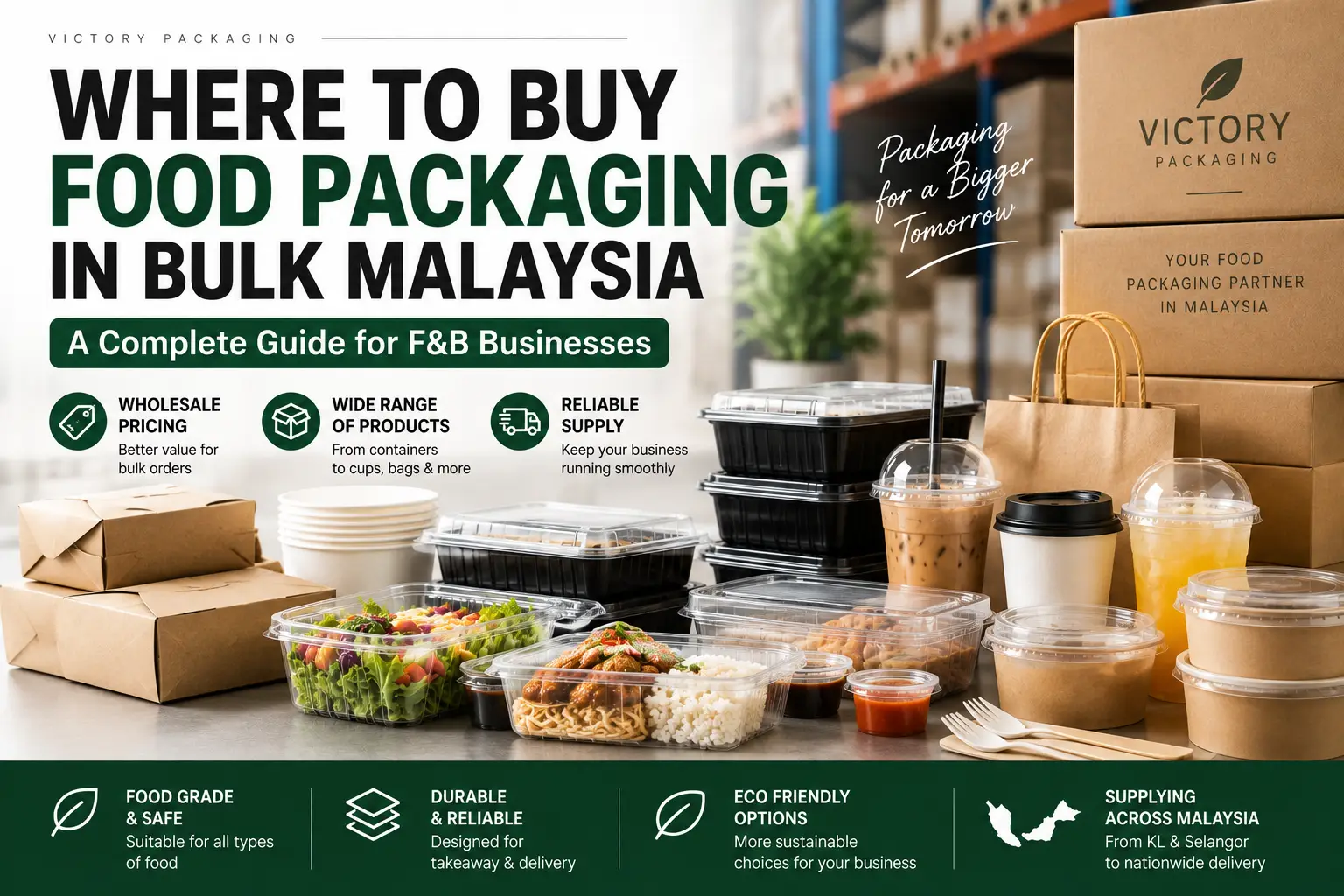
Where to Buy Food Packaging in Bulk Malaysia
Where to Buy Food Packaging in Bulk Malaysia? For restaurants, cafes, bakeries, caterers, cloud kitchens and takeaway businesses, food packaging is a regular operating expense....

For restaurants, cafes, bakeries, caterers, cloud kitchens and takeaway businesses, food packaging is a regular operating expense.
From takeaway containers and PP food containers to beverage cups, lids, cutlery and food bags, businesses can go through thousands of packaging pieces every month.
Buying food packaging in bulk can help businesses manage costs, maintain consistent stock and simplify purchasing.
However, choosing the right supplier is just as important as finding a competitive price.
A reliable food packaging supplier in Malaysia should provide suitable products, consistent availability, practical wholesale pricing and dependable delivery.
Buying packaging in small quantities may be convenient when starting a business, but growing F&B operations often require a more organised purchasing approach.
Bulk purchasing can provide several advantages.
Wholesale packaging prices are generally more suitable for businesses purchasing larger quantities.
When a restaurant uses hundreds or thousands of containers every month, even a small difference in unit price can have a meaningful impact on total packaging costs.
Running out of food containers during a busy weekend can disrupt restaurant operations.
Maintaining sufficient packaging inventory gives businesses more confidence when handling daily takeaway and delivery orders.
Instead of repeatedly ordering small quantities, businesses can plan packaging purchases around their expected monthly consumption.
This can reduce administrative work and make inventory planning easier.
Using the same packaging products consistently can help maintain a uniform presentation across takeaway and delivery orders.
This is particularly useful for restaurants with multiple branches or businesses that receive a high volume of delivery orders.
A professional food packaging wholesaler in Malaysia may supply a wide range of products for different F&B applications.
Common categories include:
Having multiple packaging categories available from one supplier can simplify purchasing for F&B businesses.
Takeaway containers are among the most commonly purchased packaging products by restaurants.
They are used for meals such as:
When buying takeaway containers in bulk, consider the container size, shape, material, lid compatibility and suitability for your menu.
PP food containers are widely used for takeaway meals and food delivery applications.
Businesses may choose PP containers based on their:
For restaurants that pack hot meals regularly, businesses should select products according to the manufacturer’s recommended usage conditions.
A container is only as practical as the lid that fits it.
When buying food containers with lids, check whether the lid provides a secure fit and whether it is compatible with the selected container.
Some systems use common or universal lids that work across multiple container depths.
This can potentially reduce the number of different lid SKUs a business needs to keep in stock.
Cafes, restaurants and beverage businesses may need to purchase cups in bulk alongside food packaging.
Common requirements include:
Buying food and beverage packaging from the same supplier can simplify procurement.
Businesses looking for more sustainable packaging can also explore eco-friendly options.
Depending on the application, this may include:
However, sustainability should not be considered separately from performance.
Businesses should also evaluate:
Not all packaging suppliers offer the same level of service.
Before placing a bulk order, consider these factors.
A supplier with a wide range of products can make purchasing easier.
Instead of dealing with several suppliers, businesses may be able to source containers, cups, lids, bags and other packaging from one place.
Compare pricing based on the quantity you actually purchase.
Don’t only compare the price of one packet.
Calculate the approximate monthly packaging cost based on your actual consumption.
Some suppliers may have minimum order requirements.
Make sure the quantity is realistic for your business and storage capacity.
A low price is not particularly useful if the product is frequently out of stock.
For high-volume F&B businesses, consistent product availability is an important consideration.
Check whether the supplier can deliver to your location and whether their delivery schedule fits your business requirements.
This becomes especially important when purchasing packaging in bulk.
If you regularly purchase the same packaging, consistent product specifications are important.
Changes in dimensions, lid compatibility or product quality can affect your packing process.
A good supplier should be able to help businesses identify suitable products based on their food type, portion size and operational requirements.
There is no single quantity that works for every restaurant.
A simple way to estimate your requirement is to calculate average daily consumption.
For example:
150 takeaway orders per day × 26 operating days = 3,900 containers per month
You can then add a reasonable safety stock based on your supplier’s lead time and your expected demand.
For example, if your business normally uses 3,900 containers per month, purchasing exactly 3,900 pieces may leave little room for unexpected increases in demand.
Consider additional requirements caused by:
Bulk purchasing can reduce packaging costs, but businesses should also consider storage.
Packaging takes up physical space.
Before placing a large order, consider:
Restaurants should keep packaging in a clean and suitable storage area away from contamination and excessive moisture.
The objective is to achieve the right balance between bulk pricing and practical inventory management.
Understanding packaging cost per order can help restaurants make better purchasing decisions.
For example:
| Packaging Item | Estimated Cost |
|---|---|
| Food container | RM0.30 |
| Lid | RM0.10 |
| Sauce container | RM0.08 |
| Cutlery | RM0.10 |
| Food bag | RM0.20 |
| Total | RM0.78 |
The actual cost will depend on the products and quantities purchased.
If a restaurant handles 3,000 takeaway orders per month:
3,000 × RM0.78 = RM2,340 estimated monthly packaging cost
This type of calculation can help businesses compare suppliers and identify opportunities to reduce packaging expenses.
For businesses with regular packaging requirements, wholesale purchasing can be more practical than repeatedly buying small quantities.
Suitable for:
More suitable for:
The right option depends on your consumption and storage capacity.
Restaurants should choose packaging based on the actual food they serve.
For example:
Nasi Lemak
Look for containers with sufficient space for rice, meat and side dishes.
Chicken Rice
Choose a container that provides enough room for rice, chicken and accompanying items without excessive movement.
Fried Rice
A sturdy container with an appropriate capacity can help maintain presentation during delivery.
Fried Meehoon
Choose suitable depth and secure lid compatibility.
Economy Rice
Larger containers may be useful for meals containing multiple dishes.
Salads
Clear containers can improve visibility and presentation.
Foods With Gravy
Secure-fitting lids and suitable container designs are particularly important.
One common problem for growing F&B businesses is having too many packaging SKUs.
For example, a restaurant might have:
This can quickly become difficult to manage.
A common-lid or compatible packaging system can help simplify inventory where applicable.
Using fewer compatible components can potentially make purchasing, storage and stock counting easier.
Businesses with multiple outlets have different purchasing requirements from single-location restaurants.
A multi-branch restaurant may need:
Working with a reliable restaurant packaging supplier can help simplify these requirements.
Centralising packaging purchases may also make it easier for the business to maintain consistent packaging across branches.
Cloud kitchens depend heavily on takeaway and delivery orders.
Because customers rarely interact with the physical restaurant, packaging becomes an important part of the customer experience.
A suitable cloud kitchen packaging supplier should be able to support:
Packaging should also support efficient kitchen operations so staff can pack orders quickly.
Before committing to a large packaging order, ask your supplier:
These questions can help prevent purchasing problems later.
For Malaysian F&B businesses, working with a local supplier can make communication and delivery easier.
A local supplier may provide better familiarity with the needs of Malaysian restaurants, cafes, caterers and takeaway businesses.
It can also make it easier to:
For businesses that depend on packaging every day, having a reliable supplier relationship can be valuable in the long term.
The best supplier is not necessarily the supplier offering the lowest price.
Instead, look at the complete value.
Consider:
Product Range + Price + Quality + Availability + Delivery + Support
A supplier that can provide reliable packaging at a competitive price while supporting your ongoing requirements can become a valuable long-term business partner.
Victory Packaging provides food packaging solutions for restaurants, cafes, bakeries, catering businesses, cloud kitchens and takeaway operators in Malaysia.
Our range includes takeaway food containers, PP food containers, beverage cups, lids, eco-friendly packaging, cutlery and other food packaging products.
Whether you are purchasing packaging for a small restaurant or looking for a reliable supplier for recurring wholesale orders, we can help you identify practical packaging solutions based on your requirements.
From everyday takeaway containers to beverage packaging and food service supplies, our goal is to make packaging procurement simpler for Malaysian F&B businesses.
You can purchase food packaging in bulk from food packaging suppliers and wholesalers serving Malaysian F&B businesses. Look for suppliers that offer suitable products, competitive wholesale pricing, reliable stock and delivery support.
Bulk purchasing can provide better unit pricing, particularly for businesses with consistent monthly packaging requirements. However, businesses should also consider delivery costs, storage and product quality.
Common wholesale products include takeaway containers, PP food containers, food containers with lids, beverage cups, paper bowls, sauce containers, cutlery, food bags and eco-friendly packaging.
The appropriate stock level depends on daily usage, operating days, supplier lead time and expected demand. Restaurants should maintain enough safety stock without exceeding their available storage capacity.
Compare the supplier’s product range, pricing, stock availability, delivery service, product consistency and customer support. It is also useful to test products before placing a large bulk order.
Yes. Many food packaging suppliers offer takeaway containers in packet and carton quantities for restaurants, cafes, caterers and other F&B businesses.
The best packaging depends on the restaurant’s menu. Consider the food type, portion size, temperature, liquid content, delivery requirements and storage needs before selecting a container.
Many suppliers support bulk purchasing for restaurants and other F&B businesses. Businesses should confirm minimum order quantities, carton quantities and delivery arrangements before ordering.
Buying compatible containers and lids together can simplify purchasing and reduce compatibility issues. Businesses should confirm that the lid securely fits the selected container.
Businesses can compare wholesale pricing, optimise container sizes, reduce unnecessary packaging SKUs, use compatible lid systems and purchase quantities based on actual consumption.