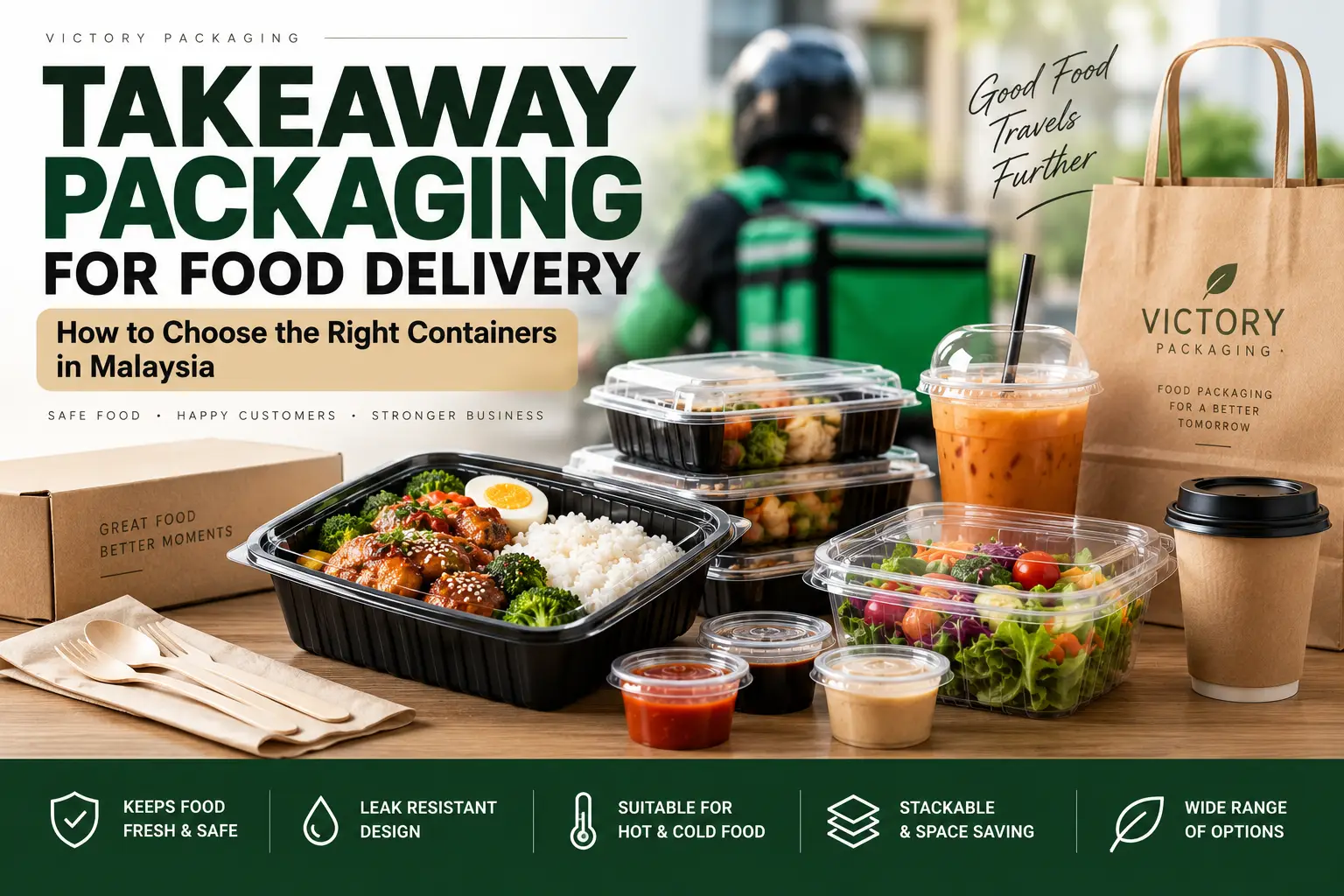
Takeaway Packaging for Food Delivery
Takeaway Packaging for Food Delivery Matters Food delivery has become an important part of the F&B industry in Malaysia. Restaurants, cafes, cloud kitchens, caterers and...

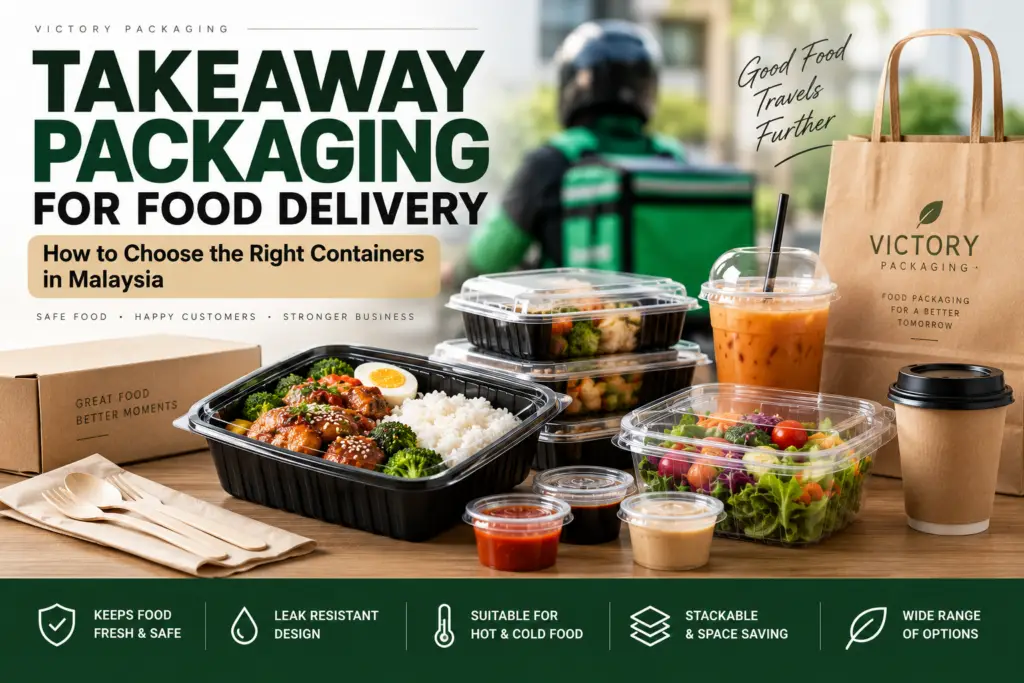
Food delivery has become an important part of the F&B industry in Malaysia. Restaurants, cafes, cloud kitchens, caterers and takeaway businesses all rely on packaging to make sure food reaches customers safely and in good condition.
The right takeaway packaging for food delivery should do more than simply hold food.
It needs to protect the meal, minimise leakage, maintain presentation and make the delivery process easier for both the restaurant and customer.
A good packaging solution can help businesses reduce packaging problems while creating a more consistent takeaway experience.
Food delivery packaging needs to perform throughout the entire journey from the kitchen to the customer.
A suitable container should ideally provide:
The right choice depends on the type of food your business prepares and how far the food needs to travel.
Different foods have different packaging requirements.
A container suitable for fried rice may not be the best choice for soup, curry or a salad.
Nasi lemak, chicken rice, fried rice and economy rice are commonly packed for takeaway and delivery.
These meals generally require containers that provide enough space for rice, meat, vegetables and sauces while keeping the food secure.
A rectangular food container with a properly fitting lid can be a practical option for many takeaway meals.
Noodles, meehoon and pasta may contain sauces or gravy that can move around during delivery.
Choose containers with enough depth and secure lids to reduce the risk of spills.
Foods containing sauces and gravy require particular attention to lid security and leakage.
A container should close firmly and remain secure even when the delivery bag is moved or tilted.
Clear food containers can be useful for salads and cold meals because customers can see the food before opening the packaging.
This can also improve food presentation.
Fried chicken, fried noodles and other crispy foods require packaging that allows the food to be packed securely while considering ventilation.
The goal is to protect the food without unnecessarily trapping steam.
One of the biggest concerns with food delivery is leakage.
A container can be strong, but if the lid does not fit properly, sauces and liquids can still escape.
When choosing a food container with lid in Malaysia, pay attention to:
A properly fitted lid helps keep food inside the container and reduces the chance of spills inside delivery bags.
For restaurants handling a large number of delivery orders, reliable lid performance can make a noticeable difference.
The container should match the portion size.
If the container is too small, food may become compressed and difficult to pack.
If it is too large, the food may move around during transportation and the restaurant may also spend more on packaging than necessary.
Consider having different container sizes for:
For example, a restaurant may use a larger container for a full rice meal and a smaller container for side dishes or additional toppings.
Using the appropriate size can improve both presentation and packaging efficiency.
Many takeaway meals are packed while they are still warm.
This means restaurants need to consider whether their selected packaging is appropriate for the food and temperature involved.
For hot food, consider:
Businesses should always follow the product manufacturer’s recommended usage conditions rather than assuming that every container is suitable for every temperature.
For restaurants serving hot meals every day, choosing suitable food-grade packaging is an important part of the takeaway process.
Food may travel through several stages before reaching the customer.
The process could look like:
Kitchen → Packing Area → Restaurant Counter → Delivery Rider → Customer
During this journey, the package may be lifted, stacked, moved or tilted.
Good delivery packaging should therefore be designed around real-world handling.
Consider whether the container:
The longer the delivery journey, the more important packaging reliability becomes.
Restaurants often need to prepare many orders at the same time.
Containers that stack neatly can help save space in:
Stackable packaging can also make it easier for staff to organise completed orders before collection.
For high-volume restaurants and cloud kitchens, practical packaging design can contribute to a more efficient workflow.
When purchasing takeaway packaging, businesses sometimes focus heavily on the container and overlook the lid.
However, the lid plays a major role in food delivery.
A good lid should:
Some packaging systems also use common or universal lids across multiple container sizes.
This can be particularly useful for businesses that want to simplify packaging inventory.
Restaurants using multiple container sizes may end up managing many different lids.
A common lid system can reduce this complexity when the same lid is compatible with multiple container depths.
Potential benefits include:
For businesses that use large quantities of takeaway containers, simplifying packaging inventory can save both time and storage space.
When comparing food delivery packaging, don’t only look at the price of one container.
Think about your complete packaging cost.
For example:
Total packaging cost = food container + lid + sauce container + beverage cup + bag + cutlery
If your restaurant handles hundreds of delivery orders every month, even a small difference in packaging cost can add up.
However, the cheapest container is not necessarily the most cost-effective.
A low-cost container that leaks, cracks or requires frequent replacement can create additional expenses.
Businesses should compare:
Restaurants with regular delivery orders may benefit from purchasing packaging in larger quantities.
Takeaway packaging wholesale can provide businesses with a more practical way to manage recurring packaging requirements.
Wholesale purchasing may offer:
Before placing a bulk order, businesses should check the minimum order quantity, storage requirements and supplier delivery schedule.
Buying too much packaging can create storage problems, while buying too little can increase the risk of running out.
There is no universal quantity because every restaurant has different order volumes.
A simple starting point is to calculate your average daily usage.
For example:
100 delivery orders per day × 26 operating days = 2,600 containers per month
You can then maintain additional stock based on your supplier’s lead time and your expected demand.
Businesses should also consider:
The objective is to maintain enough packaging without unnecessarily filling your storage area.
Cloud kitchens have particularly high packaging requirements because most orders are prepared for delivery rather than dine-in customers.
For a cloud kitchen packaging supplier, packaging should ideally support:
Since packaging becomes part of almost every order, cloud kitchens should carefully evaluate the reliability and cost of their packaging system.
Cafes typically require a combination of food and beverage packaging.
Common requirements include:
A supplier with a wide range of products can make it easier for cafes to manage their packaging purchases.
Restaurants may require a wider range of food packaging depending on their menu.
For example:
Nasi Lemak:
Meal containers, sauce containers and cutlery.
Chicken Rice:
Food containers with secure lids and sauce containers.
Fried Rice:
Sturdy takeaway containers with suitable capacity.
Meehoon:
Containers with sufficient depth and secure lids.
Economy Rice:
Larger meal containers suitable for multiple food portions.
Soups and Gravy:
Containers designed for liquid or semi-liquid foods.
Choosing packaging based on your actual menu can help improve delivery reliability.
The best packaging material depends on the food, budget and business requirements.
Plastic food containers can be practical for many takeaway applications because they are lightweight and available in different shapes and sizes.
Paper and fibre-based packaging can be suitable for selected food applications and businesses looking for more environmentally conscious options.
When considering eco-friendly takeaway packaging, businesses should evaluate both sustainability and practical performance.
Consider:
Sustainable packaging still needs to perform effectively throughout the delivery process.
Your supplier can have a major impact on your packaging costs and operations.
When comparing a takeaway packaging supplier Malaysia, consider:
Can the supplier provide containers, lids, cups, bags, cutlery and other packaging products?
Does the supplier offer competitive wholesale pricing for your required quantity?
Are your commonly used packaging products consistently available?
Can the supplier deliver to your location within a suitable timeframe?
Can the supplier help you select packaging based on your food and business requirements?
Can the supplier support larger or recurring orders as your business grows?
Choosing the right supplier is particularly important for restaurants that rely on packaging every day.
Restaurants can avoid many packaging problems by paying attention to a few common mistakes.
Different foods have different requirements. A single container may not be suitable for every menu item.
The cheapest packaging may not provide the best value if it results in leakage or damaged food.
A good container is useless if the lid does not fit securely.
Excessive stock can consume valuable storage space.
Insufficient stock can cause emergency purchases or disrupt takeaway operations.
Businesses should test packaging with their actual food and delivery process before committing to a large quantity.
Before purchasing takeaway packaging, ask:
Food
Container
Lid
Operations
Cost
Supplier
Victory Packaging supplies food packaging solutions for restaurants, cafes, bakeries, catering businesses, cloud kitchens and takeaway operators across Malaysia.
Our range includes takeaway food containers, PP food containers, beverage cups, lids, eco-friendly packaging and other food service packaging solutions.
Whether you are looking for packaging for nasi lemak, chicken rice, fried rice, meehoon, salads, desserts or other takeaway meals, choosing the right packaging can help your business operate more efficiently.
For businesses purchasing packaging regularly, we also provide practical solutions for wholesale and bulk packaging requirements.
Need takeaway packaging for food delivery?
Explore our range of food packaging products or contact Victory Packaging to discuss your requirements and request a quotation.
The best takeaway packaging depends on the type of food, portion size, temperature, liquid content and delivery distance. Restaurants should choose containers and lids that are suitable for their specific menu and delivery requirements.
Food containers with secure-fitting lids and suitable material are commonly used for delivery. The container should be selected according to the food being packed, particularly for hot, oily or liquid-based meals.
Use a suitable container with a properly fitting lid and test the packaging with your actual food before placing a large order. Packaging should also be handled and stacked correctly during delivery.
Takeaway packaging can be purchased from specialised food packaging suppliers and wholesalers in Malaysia. Businesses should compare product range, pricing, stock availability, delivery and customer support.
Wholesale purchasing can provide a lower unit cost depending on quantity and supplier pricing. Businesses should compare the complete cost, including delivery, storage and packaging quality.
Cloud kitchens typically need packaging that is durable, stackable, secure during delivery and practical for high-volume operations. Food containers, lids, sauce containers, beverage cups and takeaway bags are commonly required.
The appropriate size depends on the portion and type of food. Restaurants should choose a container that provides enough space without leaving excessive empty space that allows food to move during delivery.
Some packaging systems are designed with common or universal lids that can fit multiple compatible container sizes. Businesses should check the manufacturer’s compatibility specifications before ordering.
Restaurants should consider product quality, pricing, stock availability, delivery, product range, minimum order quantities and customer support when selecting a takeaway packaging supplier.