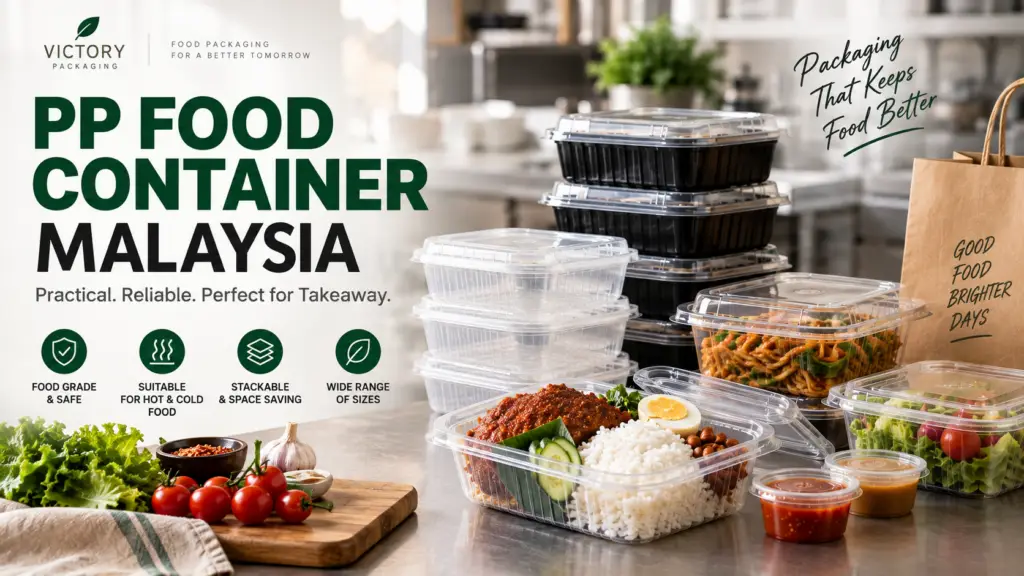
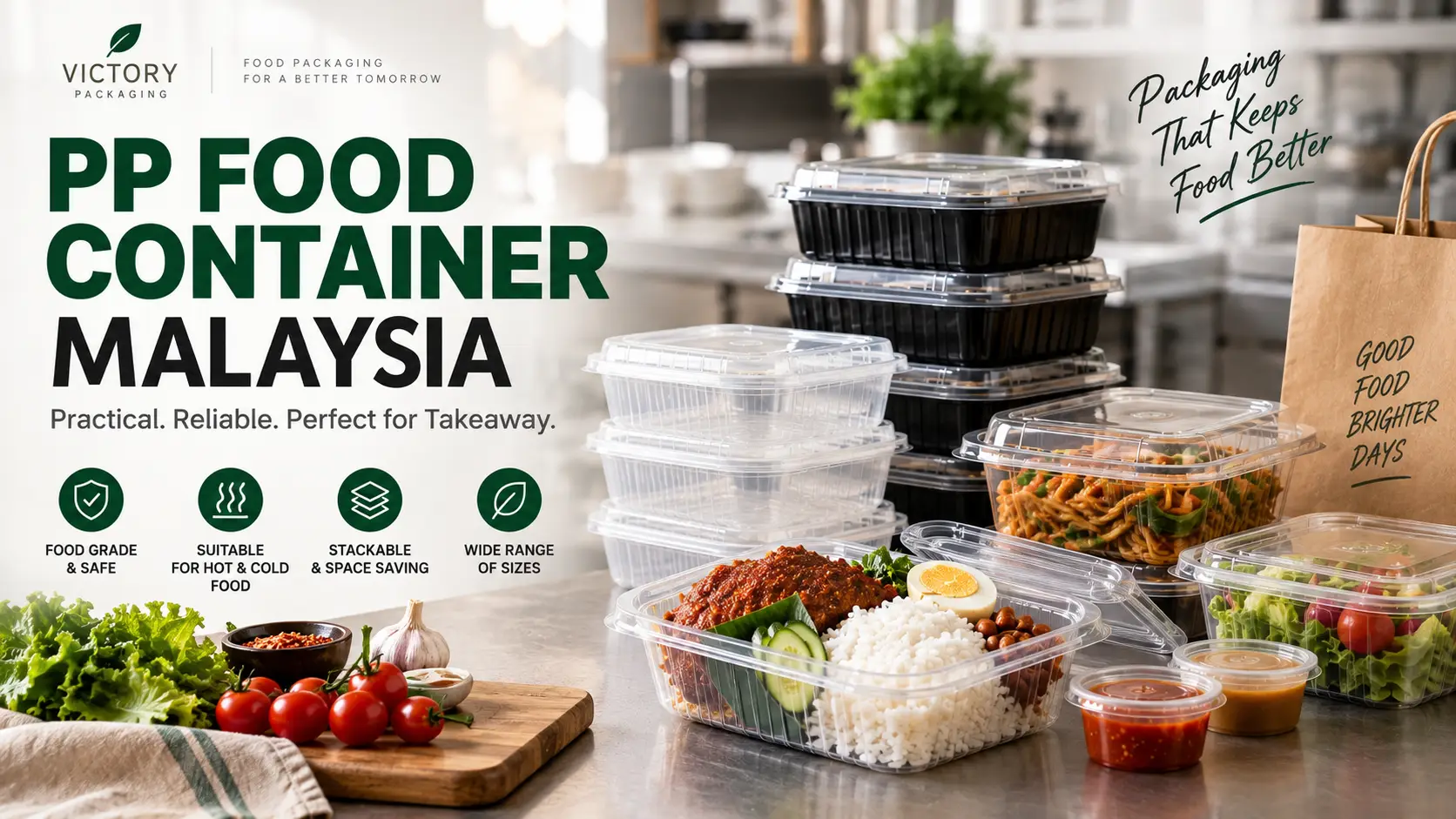
For restaurants, cafes, caterers, cloud kitchens and takeaway businesses, choosing the right food container is an important part of daily operations.
A suitable container needs to hold food securely, fit the right portion size, work well with its lid and withstand normal handling during takeaway and delivery.
PP food containers are a practical packaging option for many F&B businesses because they are lightweight, durable and available in different sizes and designs.
But not every food container is suitable for every type of food.
The right choice depends on your menu, portion sizes, delivery requirements, storage space and purchasing volume.
What Is a PP Food Container?
PP stands for polypropylene, a type of plastic commonly used for food packaging and food storage applications.
PP food containers are commonly used by restaurants and food businesses for takeaway meals, food delivery, catering and prepared food.
Depending on the product design, PP containers may be available in different:
Capacities
Shapes
Depths
Colours
Lid designs
Packaging quantities
For businesses that require takeaway packaging regularly, PP containers can provide a practical balance between functionality, durability and cost.
Why Are PP Food Containers Popular for Takeaway?
There are several reasons why PP containers are commonly used for takeaway and food delivery.
Lightweight
PP containers are relatively lightweight, making them practical for takeaway orders and delivery.
This can also help businesses manage the overall weight of packed orders.
Durable
A suitable PP container can provide reliable performance during normal handling, stacking and transportation.
This is particularly important for restaurants preparing large numbers of takeaway orders every day.
Easy to Stack
Many food container designs are stackable, allowing businesses to organise packaging more efficiently.
Stackability can be especially useful in:
Restaurant kitchens
Storage rooms
Cloud kitchens
Catering operations
Packaging areas
Available in Different Sizes
Different meals require different container capacities.
PP food containers are available in various sizes, allowing businesses to choose packaging based on their portion requirements.
Suitable for Different Food Applications
Depending on the specific product and manufacturer’s recommended usage, PP containers can be used for a wide range of takeaway food applications.
What Can You Pack in a PP Food Container?
The best container depends on the food being served.
A restaurant should consider the food type, portion size, moisture level and delivery requirements before selecting a container.
Nasi Lemak
Nasi lemak is a common takeaway meal in Malaysia and usually contains rice, sambal, meat or egg and additional side dishes.
A rectangular food container can provide enough space to organise different food components while keeping the meal compact for takeaway.
Chicken Rice
Chicken rice businesses can use suitable food containers to pack rice, chicken and accompanying side dishes.
The container should provide sufficient capacity without leaving excessive empty space.
Fried Rice
Fried rice is commonly served for takeaway and delivery.
A suitable container should provide enough space for the portion while allowing the lid to close securely.
Fried Meehoon
Fried meehoon and other noodles can be packed in containers with suitable depth and capacity.
Secure lid compatibility is particularly important when food needs to travel through delivery.
Economy Rice
Economy rice can contain several different dishes in one meal.
A larger food container may be suitable when the meal contains rice, vegetables, meat and other side dishes.
Salads
Clear food containers can be useful for salads because customers can see the contents without opening the package.
This can improve presentation for takeaway and delivery orders.
Foods With Sauce or Gravy
Meals containing sauces and gravy require suitable packaging to reduce the possibility of leakage.
Businesses should choose a container and lid combination that is appropriate for the food being packed.
PP Food Container With Lid: Why the Lid Matters
When choosing a food container with lid in Malaysia, don’t focus only on the container itself.
The lid is an equally important part of the packaging system.
A properly fitted lid can help:
Keep food contained
Reduce leakage
Protect food during transportation
Improve stacking
Make packing easier
Provide a better customer experience
For takeaway and delivery businesses, a container with a secure-fitting lid can help reduce common packaging problems.
Always check the manufacturer’s compatibility specifications before combining containers and lids.
Common Lid Systems Can Simplify Packaging
Some food packaging systems are designed around common or universal lids that can fit multiple compatible container depths.
This can be useful for businesses managing several container sizes.
Instead of keeping many different lid SKUs, a compatible common-lid system may help simplify:
Inventory management
Storage
Stock counting
Reordering
Kitchen operations
For restaurants using thousands of containers every month, reducing packaging complexity can make daily operations easier.
How to Choose the Right PP Food Container Size
Container capacity should match the portion you are selling.
A container that is too small can make food difficult to pack.
A container that is too large can allow food to move around during delivery and may also increase packaging costs.
Before selecting a size, consider:
1. Food Portion
How much food is normally included in one order?
2. Food Type
Is the meal dry, oily, saucy, liquid or mixed?
3. Presentation
Does the food need to be separated or arranged neatly?
4. Delivery
How far does the food normally travel?
5. Storage
How many containers can your kitchen or warehouse store?
6. Cost
What is the packaging cost per order?
The ideal container is not necessarily the largest one.
It should provide enough capacity while remaining practical for your operation.
What Size Food Container Should a Restaurant Use?
There is no universal container size for every restaurant.
Different menu items require different capacities.
For example:
Food Application
Packaging Consideration
Nasi Lemak
Enough space for rice and side dishes
Chicken Rice
Suitable depth for rice and meat
Fried Rice
Appropriate capacity for a full meal
Fried Meehoon
Sufficient depth and secure lid
Economy Rice
Larger capacity for multiple dishes
Salad
Clear container for presentation
Side Dish
Smaller container
Sauce
Dedicated sauce container
Businesses should test their actual menu portions before ordering large quantities.
PP Food Container vs Other Takeaway Packaging
Different food packaging materials have different advantages.
PP containers are commonly chosen when businesses need practical, lightweight and durable packaging for takeaway and delivery.
Paper-based packaging may be preferred for certain food applications or businesses looking for specific sustainability characteristics.
The best option depends on:
Food type
Temperature
Moisture
Strength requirements
Storage
Cost
Presentation
Disposal considerations
Rather than choosing packaging based only on material, businesses should evaluate the complete application.
Are PP Food Containers Suitable for Hot Food?
Suitability for hot food depends on the specific PP container and its manufacturer’s recommended conditions.
Businesses should always check the product specifications before using any food container for hot food or reheating.
For restaurants serving hot meals, consider:
Material suitability
Temperature limits
Lid design
Steam management
Food contact suitability
Manufacturer recommendations
Do not assume that every PP container has the same heat or microwave characteristics.
What Makes a Good Takeaway Container?
A good takeaway container should support both the food and the restaurant’s operations.
Look for:
Secure Closure
The lid should fit properly and remain secure during normal handling.
Suitable Capacity
The container should match your actual food portion.
Durable Construction
The container should be suitable for your intended takeaway and delivery application.
Stackability
Stackable containers can help save storage space and improve kitchen organisation.
Practical Cost
The packaging cost should make sense for your menu pricing and order volume.
Consistent Supply
Your supplier should be able to support your recurring packaging requirements.
How PP Food Containers Can Improve Restaurant Operations
Packaging affects more than just the final product.
It also affects how efficiently your team works.
A practical food container can help staff:
Pack meals faster
Stack completed orders
Organise packaging
Reduce storage problems
Standardise takeaway orders
Manage high-volume delivery periods
For busy restaurants, small improvements in packaging workflow can become significant over time.
Buying PP Food Containers Wholesale
Restaurants that use large quantities of takeaway packaging may benefit from purchasing PP food containers wholesale.
Bulk purchasing can help businesses manage their packaging costs and maintain consistent stock.
Before ordering in bulk, compare:
Price per packet
Pieces per packet
Packets per carton
Container size
Lid availability
Minimum order quantity
Delivery cost
Storage requirements
For example, Victory Packaging’s 1000ML PP Food Container + Lid is packed at:
50 sets per packet 5 packets per carton
This type of packaging information makes it easier for businesses to calculate their monthly requirements and purchasing budget.
How Much Does a PP Food Container Cost?
The price of a PP food container depends on factors such as:
Container size
Material
Lid type
Quantity purchased
Packaging configuration
Supplier
Delivery requirements
Wholesale pricing can be more attractive for businesses purchasing larger quantities.
Rather than comparing only the price of one packet, calculate your cost per container or cost per complete set.
This gives you a more accurate comparison between suppliers.
How to Calculate Your Monthly Container Requirement
A simple calculation can help businesses estimate how many containers they need.
For example:
120 takeaway orders per day × 26 operating days = 3,120 containers per month
If the business also uses containers for side dishes, catering orders or promotional periods, additional stock may be required.
Consider keeping safety stock based on:
Average daily usage
Supplier lead time
Weekend demand
Public holidays
Promotions
Catering orders
Seasonal demand
The goal is to avoid both overstocking and running out of packaging.
PP Food Containers for Cloud Kitchens
Cloud kitchens depend heavily on takeaway and delivery orders.
Since most customer interaction happens through delivery platforms, packaging becomes an important part of the overall customer experience.
A suitable container should support:
Fast packing
Secure delivery
Easy stacking
Consistent presentation
High-volume operations
Efficient storage
For cloud kitchens, packaging should be selected based on the actual menu rather than simply choosing the cheapest available option.
PP Food Containers for Catering Businesses
Catering businesses have different packaging requirements because they may prepare large quantities of food at once.
They may require containers for:
Individual meals
Event meals
Side dishes
Sauces
Desserts
Food portions
For catering orders, consistency is particularly important.
Using standardised packaging can help simplify preparation, packing and transportation.
Common Mistakes When Buying PP Food Containers
Choosing Only Based on Price
The cheapest product may not provide the best overall value.
Consider quality, lid compatibility, delivery and product consistency.
Buying the Wrong Size
An oversized container can increase costs, while an undersized container can affect food presentation.
Ignoring the Lid
A container and lid should be treated as one packaging system.
Buying Too Much
Large quantities can become difficult to store.
Buying Too Little
Insufficient stock can disrupt restaurant operations during busy periods.
Not Testing Before Bulk Purchasing
Always test the packaging with your actual food before committing to a large order.
How to Choose a PP Food Container Supplier in Malaysia
If you regularly purchase takeaway packaging, your supplier can have a significant impact on your business.
When comparing a food container supplier in Malaysia, consider:
Product Range
Can the supplier provide different container sizes, lids and other packaging products?
Wholesale Pricing
Are the prices competitive for your required purchasing volume?
Stock Availability
Can the supplier consistently provide the products you use?
Delivery
Can the supplier deliver according to your operational requirements?
Product Consistency
Are dimensions, materials and lid compatibility consistent between orders?
Customer Support
Can the supplier recommend suitable packaging based on your food and business requirements?
Why Choose Victory Packaging?
Victory Packaging provides food packaging solutions for restaurants, cafes, bakeries, caterers, cloud kitchens and takeaway businesses across Malaysia.
Our range includes:
PP food containers
Takeaway food containers
Food containers with lids
Beverage cups
Food packaging
Eco-friendly packaging
Cutlery
Other F&B packaging solutions
We understand that different businesses have different packaging requirements.
Whether you need packaging for nasi lemak, chicken rice, fried rice, meehoon, economy rice, salads or other takeaway meals, the right container can help make daily operations more efficient.
For businesses purchasing regularly, we also support wholesale and bulk packaging requirements.
Looking for PP food containers in Malaysia?
Explore our food packaging range or contact Victory Packaging for product recommendations and a wholesale quotation.
Frequently Asked Questions
What is a PP food container?
A PP food container is a food packaging container made from polypropylene. PP containers are commonly used for takeaway meals, food delivery, catering and prepared food applications.
Are PP food containers suitable for takeaway?
PP food containers can be suitable for many takeaway applications. The appropriate container depends on the food type, portion size, temperature and manufacturer’s recommended usage conditions.
What food can I put in a PP container?
PP food containers can be used for various takeaway foods depending on the specific product, including nasi lemak, chicken rice, fried rice, meehoon, economy rice, salads and other prepared meals.
Are PP food containers microwave safe?
Some PP food containers may be designed for microwave use, while others may not be. Always check the specific product specifications and manufacturer’s recommendations before microwaving.
What is the best food container size for takeaway?
The best size depends on the portion and type of food. Restaurants should test different capacities with their actual menu before purchasing containers in bulk.
Where can I buy PP food containers in Malaysia?
PP food containers are available from food packaging suppliers and wholesalers in Malaysia. Businesses should compare product quality, pricing, lid compatibility, availability and delivery before choosing a supplier.
Can PP food containers come with lids?
Yes. PP food containers can be supplied with compatible lids. Some packaging systems may also offer common or universal lids for multiple compatible container sizes.
Are PP food containers good for food delivery?
Suitable PP containers can be practical for food delivery because they are lightweight, stackable and available in different sizes. Businesses should choose containers and lids according to their specific food and delivery requirements.
Can restaurants buy PP food containers wholesale?
Yes. Restaurants, cafes, caterers and cloud kitchens can purchase PP food containers in bulk or wholesale quantities depending on the supplier’s packaging and minimum order requirements.
How do I choose a PP food container supplier?
Consider the supplier’s product range, pricing, stock availability, delivery, product consistency and customer support. It is also recommended to test products before placing a large order.
For restaurants, cafes, caterers, cloud kitchens and takeaway businesses, choosing the right food container is an important part of daily operations. A suitable container needs...