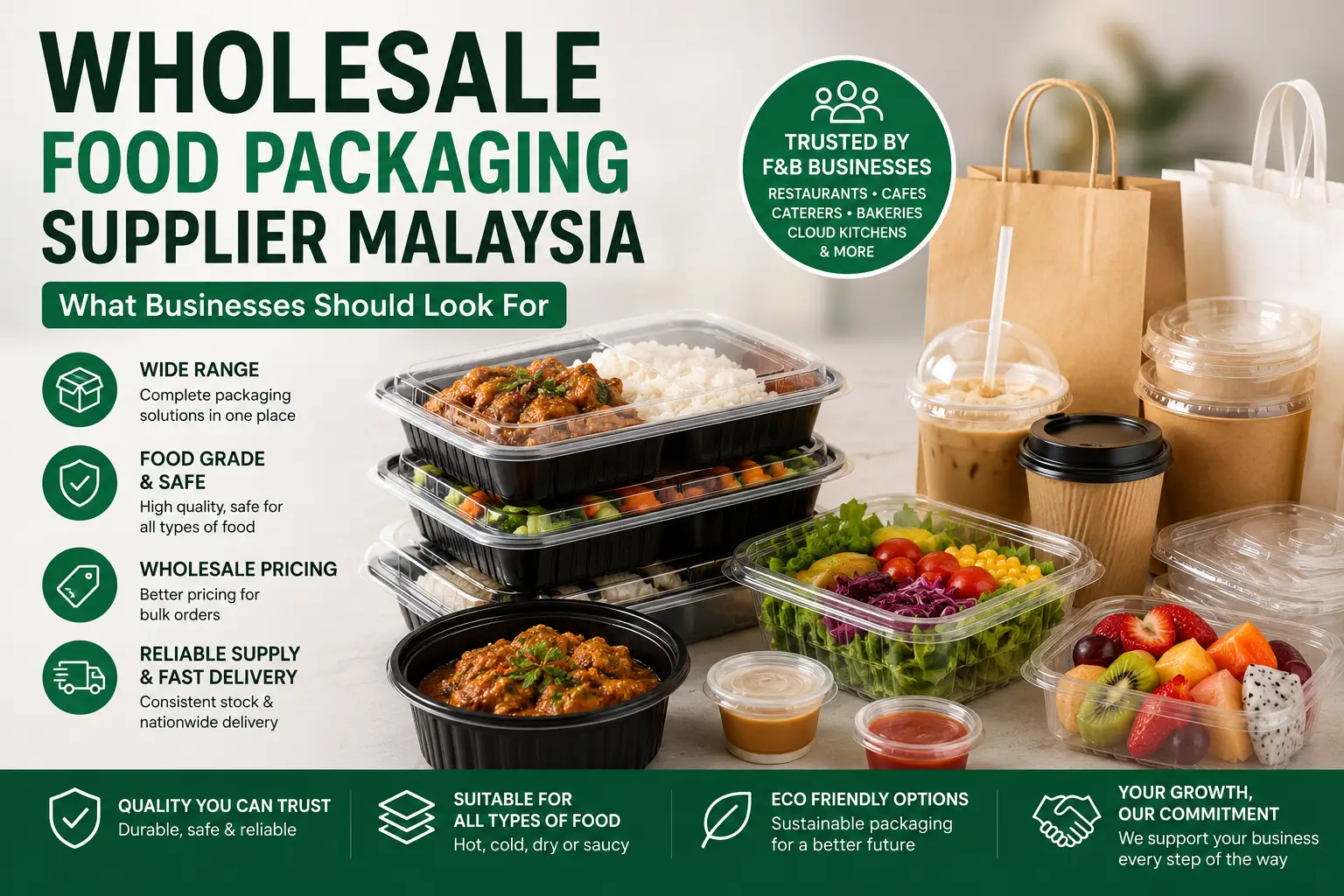
Wholesale Food Packaging Supplier Malaysia: What Businesses Should Look For
For restaurants, cafes, bakeries, catering businesses, cloud kitchens and takeaway brands, packaging is something you need every day. A food container may look like a...

For restaurants, cafes, bakeries, catering businesses, cloud kitchens and takeaway brands, packaging is something you need every day.
A food container may look like a simple business expense, but choosing the right packaging supplier can have a major impact on your operating costs, food presentation, customer experience and daily workflow.
For businesses that purchase packaging regularly, working with a reliable wholesale food packaging supplier in Malaysia can make it easier to control costs, maintain consistent product quality and keep essential packaging items in stock.
But how do you know which supplier is right for your business?
This guide explains what F&B businesses should consider when comparing wholesale food packaging suppliers in Malaysia.
Buying food packaging wholesale is usually more practical for businesses that use containers, cups, lids and other packaging products regularly.
Instead of purchasing small quantities whenever stock runs low, businesses can order larger quantities based on their expected usage.
Some of the main advantages include:
For busy restaurants and takeaway businesses, reliable packaging supply can also reduce unnecessary interruptions to daily operations.
Not every packaging supplier offers the same range, pricing or level of service.
Before choosing a supplier, it is worth considering several important factors.
A good wholesale food packaging supplier should be able to support more than one packaging requirement.
Depending on your business, you may need:
Having multiple products available from one supplier can make purchasing much easier.
Instead of contacting several different suppliers for containers, cups and accessories, you can consolidate your orders and simplify your procurement process.
For growing F&B businesses, this can also make inventory management more straightforward.
Different foods require different types of packaging.
A container suitable for a cold salad may not be the best option for hot rice, curry or oily food.
When comparing wholesale food containers, consider:
For example, businesses selling hot meals may need packaging with better heat resistance, while cafes and dessert businesses may place greater importance on appearance and product visibility.
The right packaging should match the food you sell and how customers receive it.
Price is important when buying wholesale, but quality should not be ignored.
Inconsistent packaging can create problems such as:
For businesses handling hundreds or thousands of takeaway orders, small packaging problems can quickly become operational problems.
A reliable food packaging supplier in Malaysia should provide products that businesses can consistently depend on.
One of the biggest reasons businesses choose wholesale packaging is cost efficiency.
However, the cheapest product is not necessarily the most economical option.
You should consider the overall value of the packaging, including:
For example, a cheaper container that frequently leaks or breaks can create more costs through replacements, refunds and unhappy customers.
A good wholesale packaging supplier should offer practical pricing while maintaining dependable product quality.
For an F&B business, running out of packaging can become a serious operational issue.
Imagine having plenty of food ingredients but not enough containers to pack customer orders.
This is why stock availability should be part of your supplier evaluation.
Ask suppliers about:
Businesses with high packaging consumption should ideally work with a supplier that understands their recurring requirements.
The packaging needs of a restaurant are different from those of a cafe or bakery.
A good supplier should understand different business requirements.
Restaurants may need:
Cafes may require:
Bubble tea businesses may need:
Bakeries may require:
Cloud kitchens often require packaging that is:
A supplier with a broad product range can make it easier for different types of F&B businesses to source their packaging from one place.
Food delivery has changed the way many Malaysian F&B businesses operate.
Packaging needs to protect food from the kitchen to the customer’s doorstep.
When choosing takeaway packaging for food delivery, consider:
The right packaging can help reduce spills and protect the appearance of food during transportation.
This is especially important for restaurants, cloud kitchens and businesses that depend heavily on delivery orders.
Sustainability is becoming increasingly important for many businesses and customers.
If your brand is looking for more environmentally conscious packaging, ask your supplier about available eco-friendly options.
Depending on your requirements, these may include:
However, businesses should still consider the practical requirements of the food before choosing packaging based only on sustainability claims.
The packaging should remain suitable for the food, delivery method and operating environment.
Location can also matter when choosing a wholesale food packaging supplier.
For businesses in Kuala Lumpur and Selangor, a supplier with reliable delivery coverage can make recurring packaging purchases easier.
This is particularly useful for restaurants and cafes that cannot afford long delays when restocking essential packaging products.
When comparing suppliers, check:
For businesses ordering regularly, dependable delivery can be just as important as product pricing.
Wholesale purchasing is not only about products.
A reliable supplier should also be easy to communicate with when you need help choosing packaging, checking availability or placing repeat orders.
Good supplier support can help businesses:
For growing businesses, having a packaging supplier that understands your requirements can save time and make procurement much easier.
The right quantity depends on your business’s average packaging consumption.
A simple way to estimate your requirement is to look at your average daily usage.
For example, if your restaurant uses approximately 100 takeaway containers per day and operates 26 days per month:
100 containers × 26 days = 2,600 containers per month
You can then add a reasonable buffer based on your business needs.
For example, a restaurant expecting approximately 2,600 containers of monthly usage may choose to maintain additional stock to protect against unexpected increases in orders or delivery delays.
However, avoid buying excessive quantities if your storage space is limited.
The goal is to balance:
Packaging cost + storage space + usage + supplier lead time
For businesses with regular packaging requirements, wholesale purchasing is usually more practical than buying packaging in small quantities.
| Wholesale Packaging | Retail Packaging |
|---|---|
| Larger quantities | Smaller quantities |
| Better suited for regular business use | Better suited for occasional use |
| Potentially lower unit cost | Higher unit cost |
| Easier recurring purchasing | More frequent restocking |
| Better for restaurants and F&B businesses | Better for low-volume requirements |
If your business uses packaging every day, comparing wholesale options can help you control your ongoing operating costs.
Before placing a large order, ask your supplier:
These questions can help you compare suppliers more effectively instead of looking only at the cheapest unit price.
Your packaging supplier is more than just another vendor.
For restaurants, cafes, bakeries, caterers and takeaway businesses, packaging is part of everyday operations.
A reliable supplier can help you maintain:
This becomes even more important as your business grows.
Instead of constantly searching for individual containers, cups and accessories, having a dependable wholesale food packaging supplier in Malaysia can give your business a more efficient way to manage packaging procurement.
Victory F&B Containers supplies a wide range of food packaging solutions for restaurants, cafes, bakeries, catering businesses, cloud kitchens and takeaway brands.
From takeaway food containers and PP food containers to beverage cups, eco-friendly packaging and food service accessories, we help Malaysian F&B businesses find practical packaging solutions for their daily operations.
Whether you need a small recurring order or wholesale food packaging for higher-volume operations, our team can help you find suitable products for your business.
Looking for wholesale food packaging in Malaysia? Contact Victory F&B Containers today to discuss your packaging requirements and get a quotation.
A wholesale food packaging supplier provides food containers, cups, lids, takeaway packaging and other food service products in larger quantities, usually at pricing designed for business customers.
Businesses can purchase wholesale food packaging from specialised packaging suppliers that provide products such as takeaway containers, food containers with lids, beverage cups, paper packaging and food service accessories.
Restaurants commonly use takeaway food containers, PP food containers, bento boxes, sauce containers, paper bowls, beverage cups and disposable cutlery. The best option depends on the type of food and delivery requirements.
Wholesale purchasing can provide a lower unit cost compared with buying small quantities, particularly for businesses with regular packaging requirements. However, businesses should also consider product quality, delivery costs and minimum order quantities.
Delivery coverage depends on the supplier. Businesses should check delivery areas, minimum order requirements and lead times before placing a bulk order.
Yes. Cafes can purchase wholesale packaging such as takeaway food containers, coffee cups, beverage cups, dessert containers, paper bags and other food service packaging based on their requirements.
Consider product range, container quality, lid fit, leak resistance, pricing, stock availability, delivery coverage and customer support. A supplier that can consistently provide the products your business uses can make ongoing purchasing much easier.